
Last Updated: 8 November 2026
Quick Summary
To find business units with parking included in the rent, confirm in writing how many bays are allocated to the unit and that they carry no separate charge, permit fee or service charge line. Check the draft lease for a parking clause stating the exact number of bays, and compare total annual costs rather than headline rent.
-
Count the bays you need at peak, not average, before you start searching.
-
Treat 'parking available' as a question, not an answer, until the landlord confirms it in writing.
-
Ask for the parking clause in the draft lease as the strongest evidence of your allocation.
-
A unit at £1,850 a month with parking at £60 per bay can cost more than one at £2,000 with bays included.
-
Watch for phrases such as 'subject to availability' that let the landlord withdraw bays later.
**Parking included in the rent: is it in writing?**We offer mixed-use units near Callington with on-site parking, roller-shutter access and CCTV security.
Table of Contents
-
Step 2: Search Commercial Units With Parking That Suit Your Trade
-
Step 3: Verify Parking Is Genuinely IncludedRead the Wording Before You Ask Anything
-
Step 5: Compare Commercial Property Lease Costs Beyond the Headline RentBuild a Like-for-Like Annual Figure
-
Step 6: Check the Lease Clauses That Protect Your Parking Rights
Why Parking Included in the Rent Changes the Deal
Two units can advertise the same rent yet differ considerably once parking is priced separately. A unit with parking included in the rent removes that uncertainty before you sign.
Below is a six-step process for finding business units with parking included in the rent, verifying the parking is genuinely part of the deal, and checking the lease clauses that protect it.
Step 1: Define Your Parking and Access Needs
Start with a count, not a feeling. Write down how many vehicles sit on site on a normal day, then add the peak: client visits, deliveries, staff who occasionally drive in.
Three questions settle most of it:
-
How many bays do you need at peak, not average? Count vehicles, not people.
-
What size vehicles arrive? A standard bay suits a car; a long-wheelbase van or a delivery lorry needs turning space and a loading area.
-
When do deliveries land? A shared unloading area works if your slots do not clash with a neighbouring tenant's.
Access matters as much as capacity. Check the approach road, turning circle and whether large vehicles can enter and leave without reversing into a busy route. Before committing, check the park's location and access to judge whether surrounding roads suit your vehicles and delivery times.
Step 2: Search Commercial Units With Parking That Suit Your Trade
Filter listings by trade, not by look. A light industrial unit with roller-shutter access and a yard serves a contractor; a semi-serviced office serves a clinic.
Use a shortlist of criteria rather than scrolling listings:
Trade type | Parking priority | Access priority |
Trades and contractors | Secure bays for vans and equipment | Roller-shutter door, loading area |
Health and professional services | Client bays near the entrance | Step-free access, clear signage |
Storage and distribution | Turning space for larger vehicles | Wide entry, unloading area |
Office-based teams | Staff bays plus visitor spaces | Public transport links nearby |
When a listing says "parking available", treat it as a question, not an answer. Once you have a shortlist, browse the available units and note which state parking as a feature of the unit rather than an optional extra.
Step 3: Verify Parking Is Genuinely Included
Verification is where most searches fall apart. A listing that mentions parking tells you a car park exists; it does not tell you the bays are yours, included in the rent, or protected for the length of your lease. Treat every mention of parking as a claim to be tested.
Read the Wording Before You Ask Anything
The phrase a listing uses is a clue to what is actually on offer. Sort them into three tiers:
-
'Parking included' or 'rent includes parking', the strongest wording, but still only a starting point. It should be matched by a specific number of bays in the particulars or the lease.
-
'Parking available' or 'car park on site', neutral. It confirms a car park exists, not that any bay is allocated to your unit or covered by the rent.
-
'Parking by separate arrangement', 'permit parking' or 'parking at additional cost', a clear signal that parking is a separate charge, even if the headline rent looks competitive.
If the particulars are silent on the number of bays, assume none are allocated until the landlord confirms otherwise in writing.
What to Ask the Property Manager
Ask these questions in writing and keep the replies, so you have something to point to if the lease is drafted differently.
-
How many parking spaces are allocated to this specific unit?
-
Are those spaces included in the quoted monthly rent, or charged separately?
-
Is the allocation fixed, or can it be changed during the tenancy?
-
Are the bays marked and reserved for the unit, or shared on a first-come basis?
-
Who manages the car park, and are there any permit or enforcement charges?
-
What happens to the parking if the unit is sublet or the lease is assigned?
-
Is the parking area within the demise of the unit, or is it a right over land retained by the landlord?
-
Are there any restrictions on vehicle size, overnight parking or commercial vehicles?
Question seven matters more than it looks. Parking within the demise is part of what you rent; a right over retained land is an easement that can be more fragile if the landlord redevelops the site. Ask which applies.
Demand Evidence, Not Reassurance
A written 'yes' is better than a verbal one, but it is not the same as a document that binds the landlord. Ask for one of the following, in order of strength:
-
The parking clause in the draft lease, the best evidence, because it is the document that will govern the tenancy.
-
A side letter referenced in the lease, acceptable if the lease expressly incorporates it, otherwise it may not be enforceable against a future landlord.
-
A written allocation schedule attached to the particulars, useful for negotiation, but confirm it will be carried into the lease before you exchange.
A common mistake is accepting a verbal "yes, parking is fine" and finding the lease silent on it. If the allocation is not written into the agreement, you have no enforceable right to it. Ask for it in the lease or in a side letter referenced by the lease.
Watch for the Wording That Moves Parking Outside the Rent
Even where parking is described as included, a few phrases can quietly move it into a chargeable category later:
-
'Subject to availability', gives the landlord room to withdraw bays if demand changes.
-
'In accordance with the landlord's parking policy', ties your rights to a document you may not have seen and that can be revised.
-
'A reasonable number of spaces', reasonable to whom, and decided by whom? Ask for a number.
Watch out: a service charge that "includes car park maintenance" is not the same as parking being included in the rent. Surface, markings and lighting maintenance can sit in the service charge while the bays are separately allocated or charged. Ask the landlord to separate the two in writing.
Confirm What 'Included' Covers
Included in the rent should mean no separate charge for the allocated bays, but confirm the boundaries:
-
Are visitor bays included, or charged per visit?
-
Is there a permit or barrier system, and is the permit fee inside the rent?
-
Are electric vehicle charge points available, and are they metered separately?
Get the answers in writing before you instruct a solicitor. It is far easier to negotiate a parking clause at heads of terms than to reopen the lease after drafts have circulated.
Step 4: Use a Commercial Property Viewing Checklist
A viewing confirms what the paperwork cannot. Bring a written checklist and work through it on site, ideally at the time of day your business is busiest.

Property manager and client inspecting business units with parking and roller-shutter doors during a viewing
-
Count the marked bays and compare to the number promised
-
Check bay sizes against your largest vehicle
-
Confirm the loading and unloading area is usable, not blocked
Before the visit, see what the park itself offers so your checklist covers the site as well as the unit.
Step 5: Compare Commercial Property Lease Costs Beyond the Headline Rent
The headline rent is rarely the full cost. Compare commercial property lease costs on a total occupancy basis, because a unit with parking included in the rent can beat a cheaper unit with parking charged on top. The difference between two units often sits in the lines below the rent.
Build a Like-for-Like Annual Figure
Take each shortlisted unit and build the same set of lines, over a full year rather than a month. Use the table below as a template and fill it in for every option so the comparison is honest.
Cost line | What to confirm |
Monthly rent | Quoted rent per calendar month, and whether VAT is payable on top |
Parking | Included in rent, or charged per bay per month; number of bays covered |
Service charge | What it covers, whether parking sits inside it, and the estimated annual figure per sq ft |
Business rates | Confirm the rateable value and who pays; check any small business rate relief eligibility |
Utilities | Metered or included, and estimated annual cost based on your usage |
Insurance | Building and contents responsibilities; who insures what |
Repair obligations | Internal only, or a share of the exterior and car park |
Deposit and guarantee | Rent deposit, bank guarantee or personal guarantee required |
Fit-out and reinstatement | Cost to fit out, and what you must remove or restore at the end |
Add the columns up over a full year, not a month. A unit advertising a lower rent with parking charged separately per bay can cost more once you multiply by your vehicle count.
Worked Example: Parking-Inclusive Versus Parking-Extra
Suppose two units are on your shortlist and you need four bays.
-
Unit A advertises £2,000 per calendar month with four bays included in the rent. Annual rent: £24,000, with no separate parking line.
-
Unit B advertises £1,850 per calendar month with parking charged at £60 per bay per month. Annual rent: £22,200, plus parking of £2,880 for four bays, giving £25,080 before service charge and rates.
On the headline figure Unit B looks £1,800 a year cheaper. Once parking is added it is £1,080 a year more expensive, before any difference in service charge or rates. Run the sum for every shortlisted unit rather than assuming the lower headline rent wins.
VAT and Service Charges: The Lines That Change the Total
Two lines catch people out more than any other.
VAT. Commercial rents are commonly subject to VAT, and parking charges usually are too. If the landlord has opted to tax the property, VAT is payable on the rent and on any separate parking charge.
Service charge. Parking maintenance, lighting, barrier repairs and car park cleaning often sit inside the service charge even when the bays themselves are included in the rent.
The Costs That Are Easy to Forget
Beyond rent, parking, service charge and rates, allow for:
-
Deposit or guarantee, often three to six months' rent, and a cash-flow cost even if it is returned.
-
Fit-out, partitioning, power, data, signage and any landlord approval costs.
-
Reinstatement, the cost of putting the unit back at the end, which can be significant for trades that alter the space.
Watch out: a service charge estimate is not a cap. Ask whether the figure is fixed, capped or open, and what happens if actual costs exceed the budget. An uncapped service charge can move your total occupancy cost materially during the tenancy.
Put the Numbers Side by Side Before You Negotiate
Once every unit has the same lines filled in, the comparison becomes a negotiation tool. If Unit B's parking charge is the reason it loses, ask whether the bays can be included in the rent at the same headline figure. If Unit A's service charge is the issue, ask for the current year's budget and the previous year's actual spend.
Annual cost of Unit A versus Unit B with four bays
Unit A: annual rent with four bays included £24,000
Unit B: annual rent £22,200
Unit B: parking for four bays £2,880
Unit B: total before service charge and rates £25,080
Step 6: Check the Lease Clauses That Protect Your Parking Rights
Parking rights live or die in the lease. A flexible lease can still remove your bays if the clause allows the landlord to reallocate space. Read the parking clause as carefully as the rent review clause.
Watch for these:
-
Allocation clause: states the exact number of bays and whether they are marked and reserved.
-
Variation clause: lets the landlord change the allocation. Ask how much notice and on what grounds.
-
Service charge clause: confirms whether parking is inside the service charge or separate.
A common mistake is signing a lease that refers to parking "as available" rather than "allocated". The first gives you no right to a bay; the second does.
Book a Viewing at Florence Road Business Park
The practical challenge is not finding a unit. It is confirming that the parking you need is written into the deal and protected for the length of your tenancy.
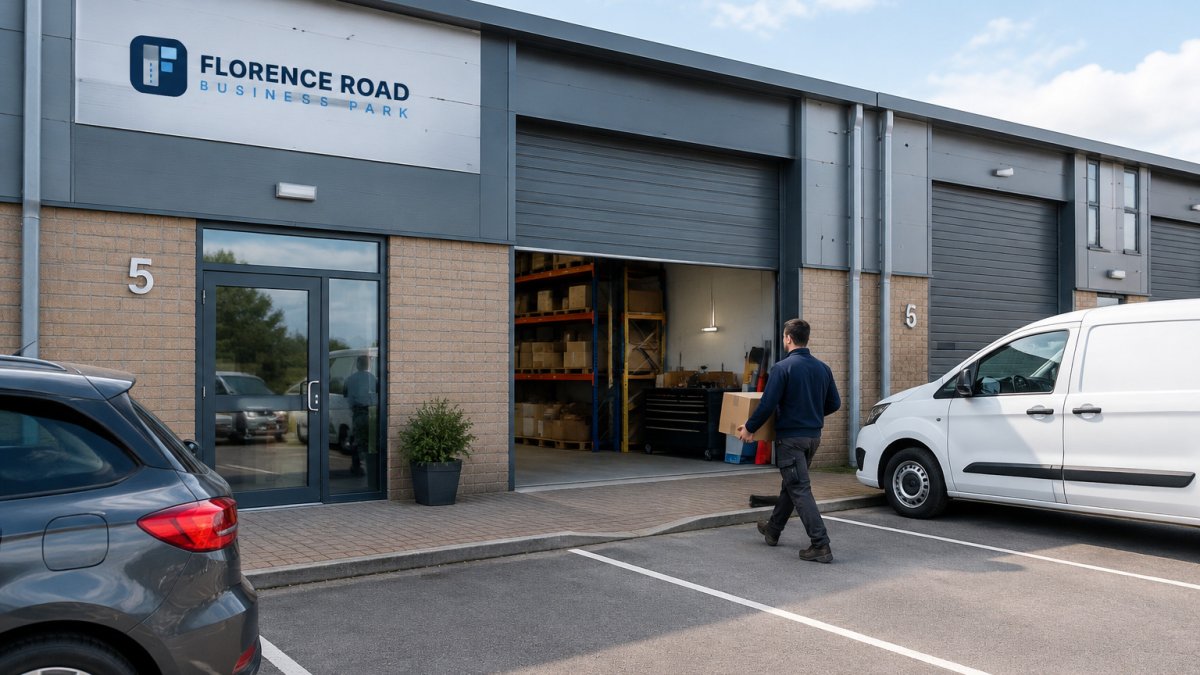
At Florence Road Business Park, we offer mixed-use units from 275 to 6,000 sq ft, just off the A388, with on-site parking, roller-shutter access and CCTV security.
Get started with Florence Road Business Park and arrange a viewing to see the units and the parking for yourself. Contact us to arrange a viewing to confirm the parking allocation for the unit you are considering.
Parking included in the rent is a simple phrase with a lot riding on it.
Frequently Asked Questions
Is parking usually included in commercial rent?
It depends on the property. Many business units with parking quote it as part of the rent, but some landlords charge for spaces separately or allocate a fixed number per unit. Always ask for the parking arrangement in writing before you sign. Check how many spaces are allocated, whether they are marked, and whether visitors or delivery vehicles can use them. If parking is not mentioned in the heads of terms, treat it as excluded until the lease confirms otherwise.
What should I check about parking before renting a business unit?
Confirm the number of allocated spaces, whether they are marked or shared, and who manages them. Ask about visitor parking, loading and unloading areas, and whether large delivery vehicles can turn on site. Check the lease for any clause that lets the landlord move or reduce your spaces. Visit at peak hours to see how full the car park gets, and ask the property manager how parking is enforced if someone parks in your bay.
What costs should I budget for beyond the headline rent on commercial units with parking?
Budget for business rates, service charges, insurance, utilities and any parking charges not included in the rent. Service charges often cover maintenance of the car park, lighting and security, so ask what they include and how they are reviewed. You may also pay a dilapidations provision at the end of the lease. Add legal fees for reviewing the lease and any fit-out costs. A clear written breakdown from the landlord helps you compare total occupancy costs rather than rent alone.
Can I use a business unit for storage, office work or light industrial purposes?
Usually yes, if the unit's planning use class and lease permit it. Mixed-use parks often allow workshops, storage and offices under one roof, which suits businesses spread across two sites. Before signing, confirm the permitted use in writing and check whether your activities need extra consent, such as for heavier machinery or customer visits. Ask the property manager directly whether your intended use fits the unit, and get the answer confirmed in the lease.