
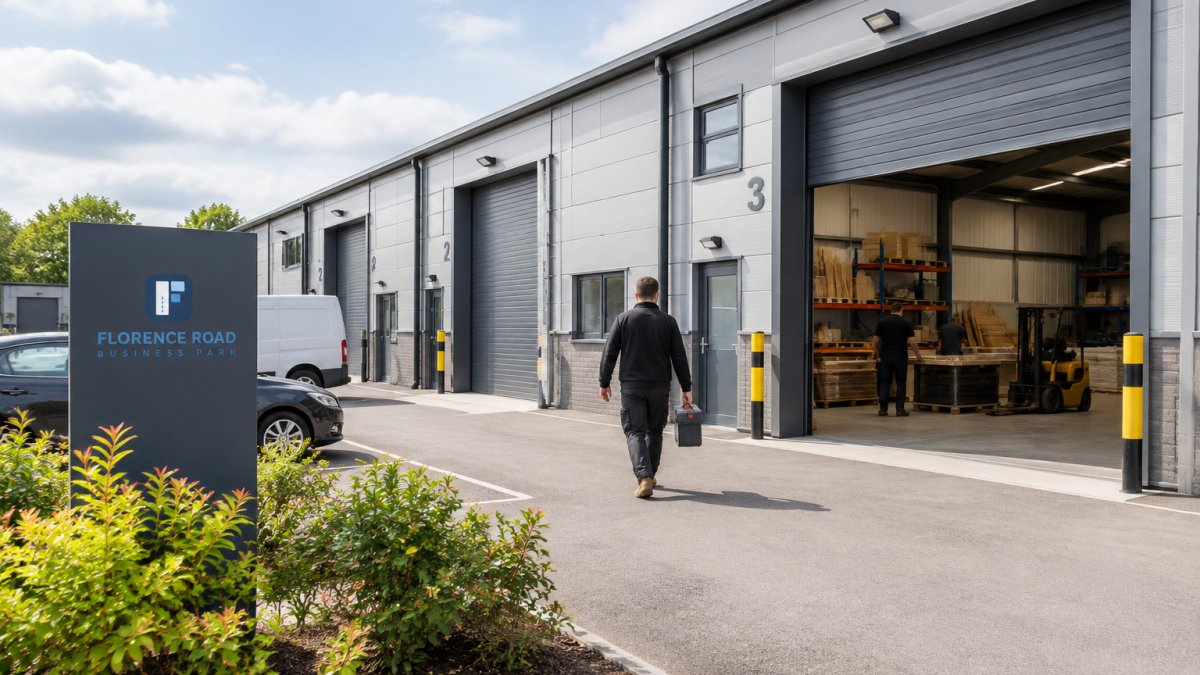
Last Updated: November 14, 2026
Quick Summary
To find an industrial park near you, search by drive time, not straight distance, and run map searches, park websites and property directories in parallel. Florence Road Business Park offers mixed-use units from 275 to 6,000 sq ft, so match the unit to your operational needs first.
-
Set your search radius by drive time at your normal working hours.
-
Confirm the planning use class with the landlord or local planning authority before shortlisting.
-
Score three to five sites on the same columns, such as size, access and parking.
-
Visit each shortlisted site during your normal delivery window to check lorry access.
-
Compare total occupancy costs, including rates, service charge and insurance, not rent alone.
**Is your current space holding you back?**Florence Road Business Park offers flexible units with roller-shutter access, CCTV and on-site parking near the A388.
Table of Contents
- Start With Your Operational Needs
- Search Methods for Finding Industrial Parks Nearby
- Industrial Park vs Industrial Estate: What the Difference Means for You
- Comparing Industrial Units to Rent: Size, Layout and Facilities
- Warehouse Space to Rent: Storage, Access and Security
- Using an Industrial Unit Viewing Checklist
- Checking Delivery Lorry Access and Total Occupancy Costs Before You Sign
- Frequently Asked Questions
Finding an industrial park near you is easier when you know what you need before you start searching. Florence Road Business Park offers mixed-use units from 275 to 6,000 sq ft, so the right fit depends on the work you do. This guide walks through how to match your operational needs to the right type of space, how to search and compare sites, and what to check before you sign.
Start With Your Operational Needs
Before you search, write down what the business actually does inside the building. A workshop, a clinic, a storage operation and an office each need different things from a site. Note your typical headcount, how much equipment or stock you hold, and whether clients visit.
Next, list the non-negotiables. Common ones include roller-shutter access for vehicles, space for delivery lorries, secure storage, and parking for staff and visitors. Keep the list short. Five or six clear requirements will narrow your search faster than a long wish list.
Watch out: Do not sign for the space you have now if your needs are growing. Leases run for years, and a unit that is slightly too big often costs less in the long run than moving again in twelve months.
Search Methods for Finding Industrial Parks Nearby
Most listings pages assume you already know which park you want. A repeatable search process is more useful, because 'near me' means different things to a courier firm, a light manufacturer and a storage business. Work through the following steps in order and keep a written record as you go.
1. Define your search radius by drive time, not distance. A site 8 miles away on a dual carriageway can be quicker to reach than one 3 miles away through town traffic. Use a mapping tool to check typical journey times at the hours your staff and deliveries travel, and note the difference between morning and evening peaks.
2. Search three ways in parallel. Map searches for "industrial park", "business park" and "industrial estate" plus your town will surface sites that do not advertise on portals. Then check the parks' own websites, since many list availability directly. Finally, use commercial property directories and agent sites, filtering by unit size, location and use class.
**3. A unit advertised as 'industrial' may not have consent for your specific operation, so confirm the lawful use with the landlord or local planning authority before you commit (Planning Permission - Change of use).
4. Build a shortlist of three to five sites and score them consistently. Use the same columns for every site: unit size in sq ft, clear height, door type and width, yard or turning space, parking count, service charge, business rates, and distance or drive time. Give each a score against your non-negotiables from the previous section. This stops the largest or cheapest unit from winning by default.
5. Visit at the time you would actually travel. Photos rarely show loading access, turning space for vehicles or the condition of shutters. A short drive around the site during your normal delivery window will tell you more than any listing.
Watch out: Do not rely on a single portal's availability. Units are often let before listings are updated, and a park's own site may show space that never appears in directories. Confirm availability by phone before travelling to view.
The article sets out a five-step search process, with the key action and timing for each step.
Step | What to do | Key point |
-
Set search radius | Check drive times at your working hours | Drive time beats straight distance |
-
Search three ways | Map searches, park websites, directories | Run all three in parallel |
-
Check use class | Confirm lawful use with landlord or planning authority | Advertised 'industrial' may not fit your use |
-
Score shortlist | Compare three to five sites on the same columns | Score against non-negotiables |
-
Visit at travel time | Drive the site during your normal delivery window | Photos miss loading access and turning space |
Industrial Park vs Industrial Estate: What the Difference Means for You
The terms are often used interchangeably, but they can describe slightly different setups. An industrial park usually refers to a planned site with consistent layout, shared facilities and a defined set of occupiers. An industrial estate is a broader term that can include older, more varied buildings.
For most small businesses, the practical difference lies in the day-to-day experience. A park is more likely to offer managed access, shared parking and a single point of contact for maintenance. An estate may give you more independence but leaves more of the upkeep to you.
Ask the landlord or agent which model applies, and what the service charge covers. You can learn more about the park's character and setup to see which model it follows. That answer will tell you more about the running of the site than the label does.
Comparing Industrial Units to Rent: Size, Layout and Facilities
Compare units on usable floor area, not just the headline size. Check ceiling height, door width, the number of loading points and whether there is a mezzanine. A 1,500 sq ft unit with a low ceiling may hold less than a 1,200 sq ft unit with a higher one.
You can view the current availability at Units on Florence Road Business Park to see the sizes and layouts on offer. Note which units include toilets, kitchen areas or office partitions, since adding these later can be costly and slow.
Make a simple comparison table with columns for size, height, access, parking and the services included. Scoring each unit against your non-negotiables makes the choice far clearer.
Warehouse Space to Rent: Storage, Access and Security
If storage is central to your business, look closely at how goods move in and out. Check the door height and width, whether a forklift or pallet truck can operate inside, and how much space you have for staging stock before dispatch.
Security matters just as much. Ask what monitoring is in place and how the site is secured out of hours. Ask the park to explain these measures, and confirm them on your own visit.
Consider your insurance too. Your insurer may ask about the security measures at the site, so get the details in writing before you commit.
Using an Industrial Unit Viewing Checklist
A structured viewing stops you forgetting things under pressure. Take this checklist with you on every visit:

Business owner inspecting a shutter door in an industrial park unit
-
Measure the usable floor area and ceiling height
-
Check the roller shutter operates smoothly and fully opens
-
Test lighting, power sockets and the consumer unit
-
Look for damp, cracks, or signs of previous water ingress
-
Confirm toilet and washing facilities work
-
Walk the access route and turning space for your largest vehicle
-
Count the car parking spaces and note any restrictions
-
Ask who is responsible for repairs, and for what
-
Ask about the service charge and what it includes
-
Check the broadband and mobile signal inside the unit
Take photos and notes at each stop. Comparing three or four sites a week later is much easier with a written record.
Checking Delivery Lorry Access and Total Occupancy Costs Before You Sign
Lorry access is one of the most overlooked factors. Visit at the time of day your deliveries arrive, and watch how long it takes vehicles to enter, turn and leave. Confirm the turning circle and any height restrictions on site. If articulated vehicles serve you, measure the yard depth against the vehicle length rather than estimating by eye.
Total occupancy costs are almost always higher than the headline rent. Ask for a written breakdown covering each of the following:
-
Rent or lease premium, the quoted figure, and whether it is exclusive or inclusive of anything.
-
Business rates, payable to the local authority, based on the rateable value of the unit multiplied by the multiplier set for the year. Small businesses may qualify for relief, so check eligibility with the billing authority rather than assuming (Business rates relief: Small business rate relief).
-
Service charge, covers shared maintenance, security and common areas. Ask what it includes, whether it is capped, and how it has changed over recent years.
-
Insurance, buildings insurance is usually the landlord's responsibility and recovered through the service charge, but contents and public liability cover are yours.
-
Utilities, confirm whether the unit is separately metered for electricity, gas and water, and who supplies them.
-
VAT, confirm in writing whether the rent and service charges carry VAT, and how it applies to your business.
-
Fit-out and reinstatement, partitioning, additional power, racking and any obligation to return the unit to its original condition at the end of the lease.
Add these together to get a realistic monthly figure, then compare that figure across your shortlist rather than comparing rents alone.
Before signing, work through a short due diligence checklist:
-
Confirm the permitted use class and any planning conditions restricting hours, noise or external storage.
-
Read the lease terms in full, including length, break clauses, rent review mechanism and repairing obligations.
-
Ask whether a schedule of condition is attached, so you are not liable for pre-existing disrepair.
-
Check for environmental risks such as previous contaminative uses, flood risk and asbestos, and request any surveys the landlord holds.
-
Confirm who is responsible for repairs to the roof, shutters and external structure.
-
Verify the service charge budget and your right to challenge it.
Watch out: A lease that looks affordable on rent alone can become expensive once rates, service charge and reinstatement obligations are added. Request the full cost picture and the draft lease before you pay a deposit, and take legal advice on the terms. For tailored advice on your situation, contact Florence Road Business Park directly to arrange a visit.
Florence Road Business Park offers mixed-use units for workshops, storage, light industrial and office use, with roller-shutter access, CCTV and on-site parking. Book a viewing to see whether a unit fits your operational needs.
Frequently Asked Questions
How do I find an industrial park near me?
Start with a map search for industrial estates and business parks within your preferred drive time, then filter listings by unit size, lease terms and access. Commercial property agents and local business networks also hold details of units that are not advertised online. Once you have a shortlist, check each site's road access, parking and security in person, and compare total occupancy costs, not only the headline rent. A quick drive past at your typical delivery times will show you how traffic really behaves on the approach roads.
What is the difference between an industrial park and an industrial estate?
The terms are often used interchangeably in the UK. An industrial estate usually refers to an older, planned cluster of units, often with mixed occupiers, while an industrial park tends to describe a more modern development with landscaped grounds and purpose-built units. Neither term guarantees a particular standard, so judge each site on its access, unit specification, parking and security rather than on its name.
What should I check before renting an industrial unit?
Confirm the usable floor area, ceiling height, loading door size and power supply against your needs. Ask for the full lease terms, including the length, break clauses, service charge, insurance rent and business rates responsibility. Check whether the unit is suitable for your intended use class and whether delivery vehicles can turn and load on site. Request a viewing at a busy time of day so you can see how access and parking actually work.
Can I use an industrial unit for storage, a workshop or an office?
Many mixed-use units can be used for storage, light industrial work or office space, but permitted use depends on the planning use class and the lease terms. Ask the landlord to confirm in writing which activities are allowed, and whether any fit-out or change of use needs consent. If you plan client visits or a professional environment, check the toilet facilities, heating and entrance arrangements before you commit.